
Training For Blood Flow: What Exercise Does
Of everything a man can do without a prescription, this has the best evidence behind it by a considerable margin.
Advice to exercise more is easy to dismiss because it accompanies every health problem there is. In this particular case the evidence is unusually specific: randomised trials of aerobic training in men with erectile dysfunction have produced measurable improvement on validated scoring instruments, and meta-analyses pooling them have found the effect holds up.
The reason is mechanistic rather than motivational, and knowing it makes the recommendation easier to act on.
Exercise is endothelial training
The endothelium lining every blood vessel produces nitric oxide, which is what tells arterial smooth muscle to relax. Erections depend on it entirely.
Endothelial nitric oxide production is stimulated by shear stress — the drag of blood moving across the vessel wall. Sustained aerobic exercise increases cardiac output and therefore increases shear stress throughout the arterial tree for the duration of the session. Repeated regularly, this upregulates the enzyme responsible for nitric oxide synthesis. The vessel becomes better at dilating, and it stays better as long as the stimulus continues.
You are not exercising the penis. You are exercising the lining of every artery in the body, and the smallest ones benefit most visibly.
Because this is an adaptation of enzyme activity rather than a structural rebuild, it appears faster than most people expect. Improvements in endothelial function have been demonstrated within weeks of starting a programme.
What the trials actually used
The protocols that produced results were unremarkable. Moderate-to-vigorous aerobic activity, around forty minutes a session, four sessions a week, sustained for six months. Walking briskly, cycling, swimming and running all appear in the literature. The men who improved most were generally those who started from the lowest fitness and those whose dysfunction had a vascular basis rather than a neurological or post-surgical one.
Nothing there requires a gym membership, specialist equipment or a coach. It requires about three hours a week and a reason to keep going.
The pelvic floor, which is a separate mechanism
Pelvic floor muscle training deserves its own mention because it works differently. The ischiocavernosus and bulbospongiosus muscles contract during erection and contribute to maintaining rigidity by compressing the veins that would otherwise drain the erectile tissue.
Trials of pelvic floor training have shown benefit, particularly for men whose complaint is losing an erection rather than achieving one — consistent with a venous rather than an arterial problem. The exercises are the same ones taught for continence: contract the muscle used to stop urinating mid-stream, hold, release, repeated in sets. It is unglamorous and it takes a couple of months to show anything.
Resistance training, indirectly
Strength work has less direct evidence for erectile function specifically, but it improves insulin sensitivity, adds lean mass, reduces visceral fat and supports testosterone. All of those feed into the same picture. The sensible reading is that resistance training helps by improving the metabolic environment rather than by acting on the arteries directly.
Cycling, and the question that always comes up
Long-distance cycling on a narrow saddle can compress the perineum, where the pudendal nerve and the arteries supplying the penis run. Numbness during a ride is the warning sign and should not be ignored. For most recreational cyclists this is easily managed — a wider or cut-out saddle, correct height, standing periodically, and shorter time in the drops. The cardiovascular benefit of cycling considerably outweighs the risk once the saddle is sorted.
What not to expect
Exercise is not a replacement for treatment and the timescales are different. Medication addresses this evening; training changes the baseline over months. Men with nerve damage from prostate surgery or long-standing diabetic neuropathy may see less benefit, because the limiting factor is the signal rather than the vessel. And the adaptation is not banked — endothelial improvements regress when training stops, on roughly the same timescale they appeared.
A realistic starting point
Thirty minutes of brisk walking, four days a week, at a pace where holding a conversation is possible but singing is not. Add pelvic floor sets while you are doing something else. Reassess in eight weeks rather than eight days.
Running both at once
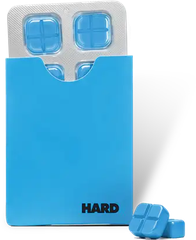
The two approaches are not competing. HardRx works on the vascular step directly and on the timescale of a single evening. Training changes how much help that step needs. Men who do both generally end up better off than men who pick one, and some find over time that they reach for the tablet less often — which is the outcome worth aiming at.
Questions this raises
Endothelial improvements have been shown within weeks, while the trials reporting improved erectile function scores generally ran around six months. Expect gradual change rather than a switch flipping.
Moderate-to-vigorous aerobic activity has the strongest evidence: brisk walking, cycling, swimming or running, roughly forty minutes four times a week. Pelvic floor training adds a separate benefit.
Trials support them, particularly where the complaint is losing an erection rather than achieving one. They take a couple of months of consistent practice to show anything.
Prolonged riding on a narrow saddle can compress the perineal nerves and arteries. Numbness during a ride is the warning sign. A suitable saddle and correct fit resolve it for most riders.
When you are ready
Five minutes of typing, an independent physician, free plain delivery.
More from the journal
Before you order
Take the dose you were prescribed and no more than one in any 24-hour period. HardRx is unsuitable alongside nitrate medication and with several heart conditions. Most side effects are mild — headache, flushing, a blocked nose, some light-headedness. None of this replaces a clinician who knows your history; read the full safety information first.
Get It Sorted
One assessment, one physician, one tablet that does both jobs.